
5.6.67 - "Never have so few pilots downed so many planes in such a short period of time."
At 7:15, the call was sounded: The IAF Commander, Major General Motti Hod, announced the beginning of Operation Focus. IAF aerially attacked the Egyptian Air Force, attacking plane after plane eventually destroying the Suchi, Mig, Alishon and Tupolg aircrafts. The Egyptian Air Force runway was severely destroyed as well. The IAF attack resulted in the destruction of 197 Egyptian aircrafts and 11 airports, in a manner of minutes. Six airports and eight radar stations were taken out of action as well.

At 09:34, a second wave of attacks began in which 107 grounded Egyptian planes were bombed. At 15:00 hours, after Israel was already awash with rumors of the Egyptian Air Force defeat, Defense Minister Moshe Dayan called for a press conference. He warned the press not to publish the amount of Arabic planes Israel destroyed, which numbered over 400 hundred.
At 02:00 hours, the Chief of General Staff, Lieutenant General Yitzchak Rabin broadcasted from nationwide radio: 400 enemy planes were destroyed. Major General Hod broadcasted that the IAF had lost 19 pilots. The following day the GOC Central Command issued a combat pamphlet amongst the soldiers stating, "Never have so few pilots downed so many planes in such a short period of time."
That same day, at 08:15 in the morning, the GOC Southern Command, Major General Yeshiahu Gabish, briefed the three division commanders of the southern front on the long awaited code words, "Red Sheet".
The Armor unit folded their camouflage netting and began their advance westward, to Sinai. The northern division, the primary base of the 7 th armored brigade and the paratrooper brigade under command of Major General Yisrael Tal, conquered Rafah and then advanced to El-Arish.
The aerial control allowed the armor ground troops to advance without hesitation. "We do not covet their land or possessions. We did not come here to destroy their land or take over their territory," said Major General Tal, Commander of the "Plada" Formation.
"Today, the Sinai Desert will recognize the force of the Plada Formation. The ground will shake beneath our feet."

In the early hours of the night, the division under the command of Major General Ariel Sharon attacked Um Tekef, an area considered the most vital fortified area of the Egyptian arsenal in the Sinai Desert. The three divisions under Major General Avraham Yaffo's command breached Bir Lachfan. The three divisions now had successfully achieved the missions they were charged with.
The King of Jordan, Hussein, who was fooled into believing the claim by the President of Egypt that Israel had been destroyed, decided to join the war.
At 9:45 that morning, the Jordan army opened fire on Jerusalem and on the Jewish communities along side the border. Hundreds of shells fell on Jerusalem.
In the late afternoon, the Jordanian troops conquered Armon Hanatziv, which was used as a UN base. Jordanian shells fell on Kibbutz Bet She'an and in Mishlosh, Kfar Saba, Kfar Sirkan, Lod, Ra'anana, Tel Baruch and Tel Aviv.
The IAF began bombing airports in Jordan, Syria and Iraq. 50 Syrian planes, 30 Jordanian and 10 Iranian planes were destroyed. Although the Jerusalem brigade conquered Armon Hanatziv that afternoon, the Jordanian shells continued falling. In response, the Chief of General Staff commanded the 55 brigade, the brigade commanded by Mordechai Gur, to begin their ascent into Jerusalem.
The Prime Minister, Levi Eshkol, spoke that night, during a conference that was assembled by the government. "In the light of the situation in Jerusalem and despite the Jordanian shells and warnings that were sent- this is our chance to finally free the Old City."
6.6.67 - The Six Day War- The Paratroops Fight For Jerusalem
At six in the morning, following intense combat, the Paratrooper Brigade under command of Major General Mordechai Gur, finally freed Ammunition Hill. 21 paratroopers were killed and dozens more were injured. The Jordanians lost 70 fighters in this battle.
During the day, the paratroopers, in cooperation with the Jerusalem brigade, conquered the neighborhoods and towns surrounding the Old City. Out of respect for the holiness of the old city, the troops avoided using armor and artillery. At 5:30 the IDF began shelling Gaza. The 7th Armored brigade, commanded by Major General Yisrael Tal, was charged with conquering Gaza. The brigade was enforced by further paratrooper troops under command of Raful. Once, Gaza was conquered, the shells ceased falling on the settlements lining the border.
In the early morning hours, the IDF conquered Latrun, Nevei Samul and Bet Ichsah, and completed the eastern siege on Jerusalem. The Harrel 10th brigade, under the command of Major General Uri Ben Ari fought until the early afternoon for the Tel Al-Tuf post, Shoaft, Mivater Hill, and the French Hill, north of the city.
In the late afternoon, the IDF troops entered Qalqiliya without any shots fired.
After 24 hours, the continuous rocket attacks ceased, and the residents of Jerusalem began emerging from their bomb shelters.
7.6.67 "The Temple Mt. is in Our Hands"
In the late hours of the morning, the 55 brigade breached the old city traveling through the Lions gate. After half an hour, the brigade commander emotionally reported on his two-way radio, "The Temple Mt. is in Our Hands," and the Israeli flag was raised facing the Western Wall.
The Chief Military Rabbi, Major General Shlomo Goran, organized the evening prayers at the Western Wall for all those troops that freed the city.
Emotions ran wild. "Hugs, shouts, confusion, men slapping each other on the shoulders, laughter, cries, and hugging once more," read Brigade Commander Gur. "I feel here, that this is my home. It is our dream! The Temple Mt.! Mt. Moriah, Abraham and Issac! The holy temple- the Maccabies, Bar Kochba, the Romans and Greeks; each with the same interests. But our emotions, are deeper than them all. We are here on the Temple Mt., our home!"
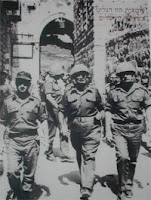
In the hours following, the Prime Minister Levi Eshkol, Defense Minister Moshe Dayan and the Chief of General Staff, Lieutenant General Yitzchak Rabin arrived at the newly liberated Western Wall. Following their arrival, the renowned Israeli singer Naomi Shemar and the Nachal Brigade choir began singing "Jerusalem of Gold"- the song most identified with the Western Wall- to the great emotion of the Paratrooper Brigades assembled in the Old City.
At that moment Shemer added a number of new verses to her famous song. She replaced the lines, "How have the wells of water dried out" and "There is no command of the Temple Mt." with "The wells of water have returned" and "A Shofar calls out on the Temple Mt."
In the meantime, the forces traveling along the northern access route, arrived at Romani, 24 km's from the Suez Canal. The IDF forces began advancing along the central access route, from J'bel Livin, and conquered Bir Chamah and Bir Jafafa. On the southern access route, the forces succeeded in arriving to Bir Hasnah, Bir Tmadah, and in the late afternoon hours arrived at the eastern entrance of the Mitle pass.
In the late afternoon the Israel Navy torpedo arrived at Sharem- El- Sheek, a few hours earlier then the paratrooper forces. The next morning, the northern Gaza strip was cleared, and at 12:00 the conquering of Chan Yunas in southern Gaza was completed after successfully warding off two attacks on the cities. That afternoon, the President of Egypt surrendered Gaza.

At 14:00 IAF planes attacked the Jordanian Armor Corps at the western passageway to the city of Nablus, and accidentally hit an IDF blockade operating in that area.
That evening the mayor of Nablus announced his surrender. The Armored forces gained control over Ramallah, Jericho, and Bethlehem. The Jordanian army's morale was completely crushed.
That night, a meeting was held by the Prime Minister of Lebanon and his Chief of General Staff on whether to join the war. The Prime minister recommended to the Chief of General Staff to join in order to lessen the Egyptian army's burden. The Chief of General Staff refused, on account of the small size of the Lebanese army, numbering just 12,000 which couldn't possibly fight for more then a few hours. Then Prime minister concluded the meeting by agreeing Lebanon could not join in the fight.
8.6.67 - Conclusion of the Losses in the Sinai: 275 IDF Soldiers Dead, 10,000 Egyptians DeadAfter a quick advancement during the night IDF soldiers reached the Suez Canal. All of the passes to the West were blocked and the Egyptian Armored forces, who attempted to reach the canal were ambushed and attacked in the Gidi and Mitleh passes. Before they escaped, the Egyptians set the Ras Sudar oil fields aflame.
On the way to the canal, IDF armored forces, which were leading the forces, defeated large Egyptian Armored forces, which were attempting to pave a way to the canal. At the end of a day of battle saturated with blood, with many Armored Corps casualties, there were thousands of Egyptian soldiers who were stranded in the heart of the desert, with no access to supplies or ammunition. An Israeli battalion of tanks managed to successfully face 60 Egyptian tanks.
At 21:30 the Egyptians announced their agreement to a cease- fire in the Sinai. The Major General of the Southern Command, Shayke Gavish, summarized the events: the IDF destroyed 600 tanks. 100 functioning Egyptian tanks were captured. Approximately 10,000 Egyptian soldiers were killed, and 3000 were captured. IDF losses in the Sinai: 275 dead, 800 soldiers injured, and 61 tanks were hit.
The commander of the Paratrooper Brigade Colonel Rephael "Raful' Eitan, was badly wounded by a bullet to the head, when he lead the Paratroops toward the canal. Raful was evacuated to a hospital, and was replaced by Colonel Aharon Davidi, the Chief Paratrooper Officer. Davidi lead the Paratroops in the final battle of the war.
9.6.67 - The Golan Heights are CapturedOn the eve of the 8th of June a cabinet meeting was called to decide how to operate against the Syrian military. The Minister of Defense was against the idea, explaining that there was no need to open a new front, and worried that it may cause Soviet intervention.
On that day, the IAF, which returned from missions in other regions, attacked the Syrian positions in the Golan Heights. On the morning of the 9th of June, after it became known that Egypt had agreed to a cease-fire, the Minister of Defense changed his position and ordered the Northern Command to attack.
At the beginning, the brigades of the region were sent into battle. The brigade in the Hula Valley attacked and captured the Syrian positions in the Gonen- Nutra region. A force from the Jordan Valley went to attack the area of Tufik; however, the attack was compromised by heavy Syrian artillery shelling and was subsequently cancelled.
In the meantime, the main breaching forces prepared for action- the 8th Brigade which was brought from the Sinai, and the Golani Brigade. The 8th Brigade breached from Givat Haem adjacent to Kefar Saled, and moved in the direction of Zaura. During the battle, a battalion of tanks advanced toward the direction of Kela, while traversing difficult terrain and meeting Syrian resistance; at the end of the battle, only two functioning tanks reached Kela.
In the wake of the 8th the Golani brigade advanced and captured the posts in Tel Azaziat and Tel Faher. In the former, there was fierce combat. In the night, the forces of the brigade advanced toward the Banias region, and captured it on the morning of the 10th of June. Additionally, the Command received reinforcements from the Jordanian front.
The 37th Brigade advanced to the heights in the region of Gonen, after the frontal Syrian posts in the region were captured beforehand. The 45th Brigade captured Tel Hamra in the night.

The 8th brigade succeeded in conquering Kantara, and the 37th brigade advanced to Kfar Nefach. The Peled division engaged in combat in the southern Golan.
The 80th paratrooper brigade forces conquered Tofik, as other forces landed in helicopters deep into the battlefield, eventually reaching the Butmia Junction. Further troops began traveling down the Hamah road. The sector brigade took control over the Syrian position along the Sea of Galiliee up until the Jacob's Daughters Bridge. The 10th brigade ascended into the region's hill in the late afternoon and had already advanced into Chushia that night.
The following morning, Saturday, the 10th of June, Major General Elad Peled received noticed of a ceasefire that had begun at 18:30. At 17:30, the helicopter force landed in Botmiya and at 18:15, the 45 th brigade conquered Massadah, in the north and the Mt. Hermon slope.
On the 12th of that month, an airlifted Golani Brigade force succeeded in capturing the Mt. Hermon region.
 Jacksonville Business Journal - June 29, 2007
 Medical-Enterprise Development Group LLC has entered a joint venture called the Florida-Israel Biomedical Initiative. The company, known as M-EDG (pronounced "image"), has one U.S. company under its umbrella. But going forward, the FL-IBI will be its focus, M-EDG President John Perry said.


 On May 14, 1948, President Truman was the first world leader to grant diplomatic recognition to the newly reborn State of Israel. Israel's first president, Chaim Weizmann, thanked Truman with a Torah scroll that now belongs to the Harry S. Truman Presidential Library.


 Television Review 'Hot House'
 New York Times June 27, 2007
 From HBO Films:


